Between the rhythms of dhak and dhunuchi: celebrating Durga Puja
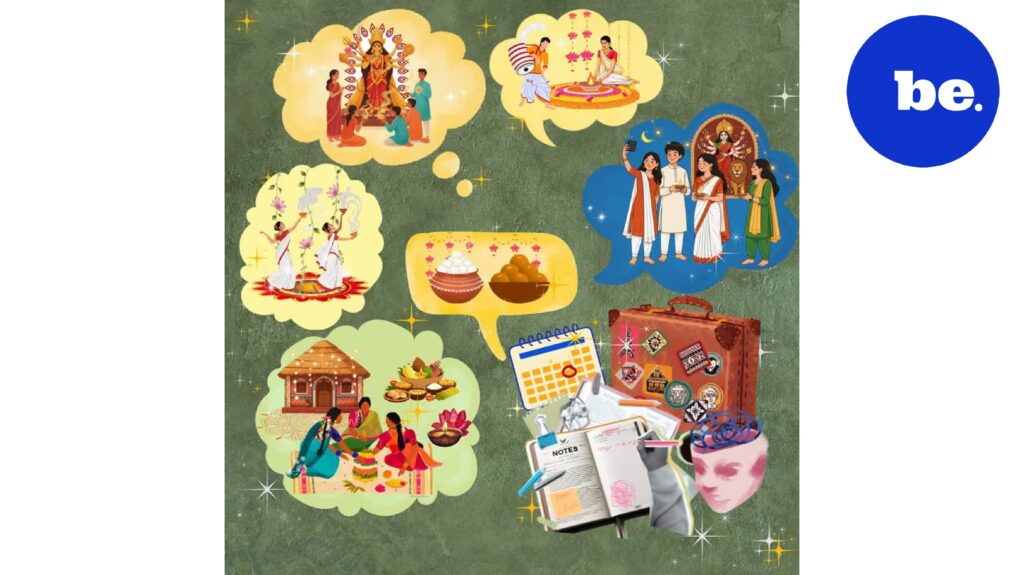
A suitcase is packed with the promise of home, but a textbook remains a fidelity that cannot be traded off right away. And somewhere between the two, a festival is cherished to be lived. For some, the suitcase is a ticket back to the hometown where a generational mandap is standing. For others, ‘being a student’ hangs on even when the air fills with the sounds of Mahalaya. A saree or dhoti awaits a night of pandal hopping with friends, and a cherished soul waits to return home. Together, these tell a story that extends beyond the rituals themselves.
The celebration of Durga Puja can be extremely dynamic depending on who is experiencing it. Still, in most cases, the true essence of Puja is realised in rural Bangladesh.
Pushpita Chakraborty (Junior, SLS) eagerly anticipates visiting her aunt’s house in Madaripur, where her family has celebrated Puja for 150 years. Durga Puja in villages is very family-oriented, where each home has a celebration of their own. They jointly contribute to all the amenities: decorating the mandap, buying and distributing spiritual offerings (proshad) for the deity, participating in rituals such as Dhunuchi Naacch, Anjali, and prayers. Priyota Banik (Junior, CSE) shared that this festival feels special because her whole family comes together once a year in their hometown.
However, with academic commitments and adulthood responsibilities, puja has become different from childhood. However, Pushpita (Junior, SLS) stated that she is able to enjoy Durga Puja more relaxed now, as she no longer needs to worry about board exams or model tests, especially when Puja takes place during semester breaks.
On the other hand, Durga Puja celebrations in Dhaka are vastly different. Here, people visit major Puja mandaps scattered around the city, a practice Gen-Z calls “pandal hopping”, admiring the contrasting themes as they go. As a result, people can spend a lot more time with their friends, often getting to introduce Durga Puja to those who are unaccustomed to it. “It’s amazing to see my friends preparing and celebrating, especially their merriment during Nabami”, shares Shadman Sharar Wasi (Junior, CSE).
The spirit of Puja finds its way into faculty members’ lives as well. Somnath Gupta (Lecturer, SLS) recalls his days as a student, when he would bring homemade নাড়ু and মোয়া to share with friends and faculty. Today, amid his academic responsibilities, he is still excited to travel to his hometown and celebrate Puja with his young nephew.
While residing in the Residential semester, our students find a way to celebrate. They dress up, light “diyas”, and paint “alponas” around the Savar Campus, despite various restrictions.
Eventually, from the alponas of Savar to the mandaps of hometowns, Puja finds its way into the lives of our students in different forms. While the diyas burn out and life returns to its familiar rhythm, all that remains is a half-empty food container in a hostel room, carrying the taste of a home, carrying footprints of festive memories.