ENH hosts international panel on transitional feminism and justice
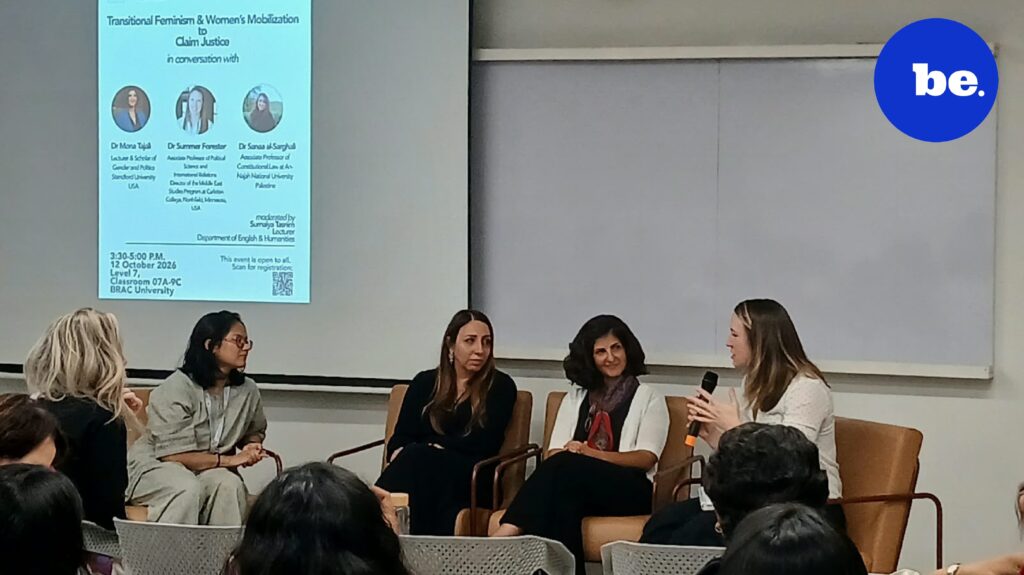
On October 12th, the Department of English and Humanities (ENH) organised a compelling panel discussion on “Transitional Feminism and Women’s Mobilisation to Claim Justice”. The session was graced by prominent figures such as Dr Mona Tajali (Lecturer, Stanford University, USA), Dr Summer Forester (Associate Professor, Carleton College, USA), Dr Sanaa al-Sarghali (Associate Professor, An-Najah National University, Palestine), and the session was moderated by Sumaiya Tasnim (Lecturer, ENH).
The discussion began with Associate Professor Forester discussing the rise and backlash against feminist movements in South America, alongside arguments about repression of feminist movements under the US administration’s right-wing conservative politics. Tajali highlighted women’s politics in post-Jina Iran, explaining how laws targeting women and religion serve as tools of oppression, emphasizing that the Mahsa Amini protests opposed the regime, not Islam, as many veiled women participated and were not West-influenced. She also addressed the Kurdish movement and questioned the states’ violent enforcement of faith. Associate Professor al-Sarghali focused on women’s participation in constitution-making in the MENA region, using Palestine as her case study.
Tajali and Al-Sarghali also emphasized the repression and male dominance over the constitutions, excluding women from decision-making, strengthening patriarchal politics. Dr Tajali warned the audience of a future of “Imaginative politics”, and Associate Professor al-Sargahli demanded, “My constitution should include me”.
The event concluded with a question-and-answer session, where Al-Sarghali addressed a student’s question about the use of “war” versus “genocide” in describing the Palestinian struggle. Referencing her legal background, she clarified that genocide had taken place alongside the war. Tasnim delivered the closing remarks, and the speakers expressed their hope for more such discussions at BRACU. As Quashimah Siddiqui Raiyan (Junior, ESS) shared, “The seminar stayed true to its name by bringing together diverse voices and creating an inclusive, transnational dialogue, developing my understanding of global feminist discourse!”