How Curiosity Shaped the 2026 Nobel Prize Winners
Isn’t it wondrous to be remembered forever as a mortal being? In 1895, Alfred Nobel, the man who invented dynamite, wrote in his will that he wanted to honour people whose work deserves to be immortal.
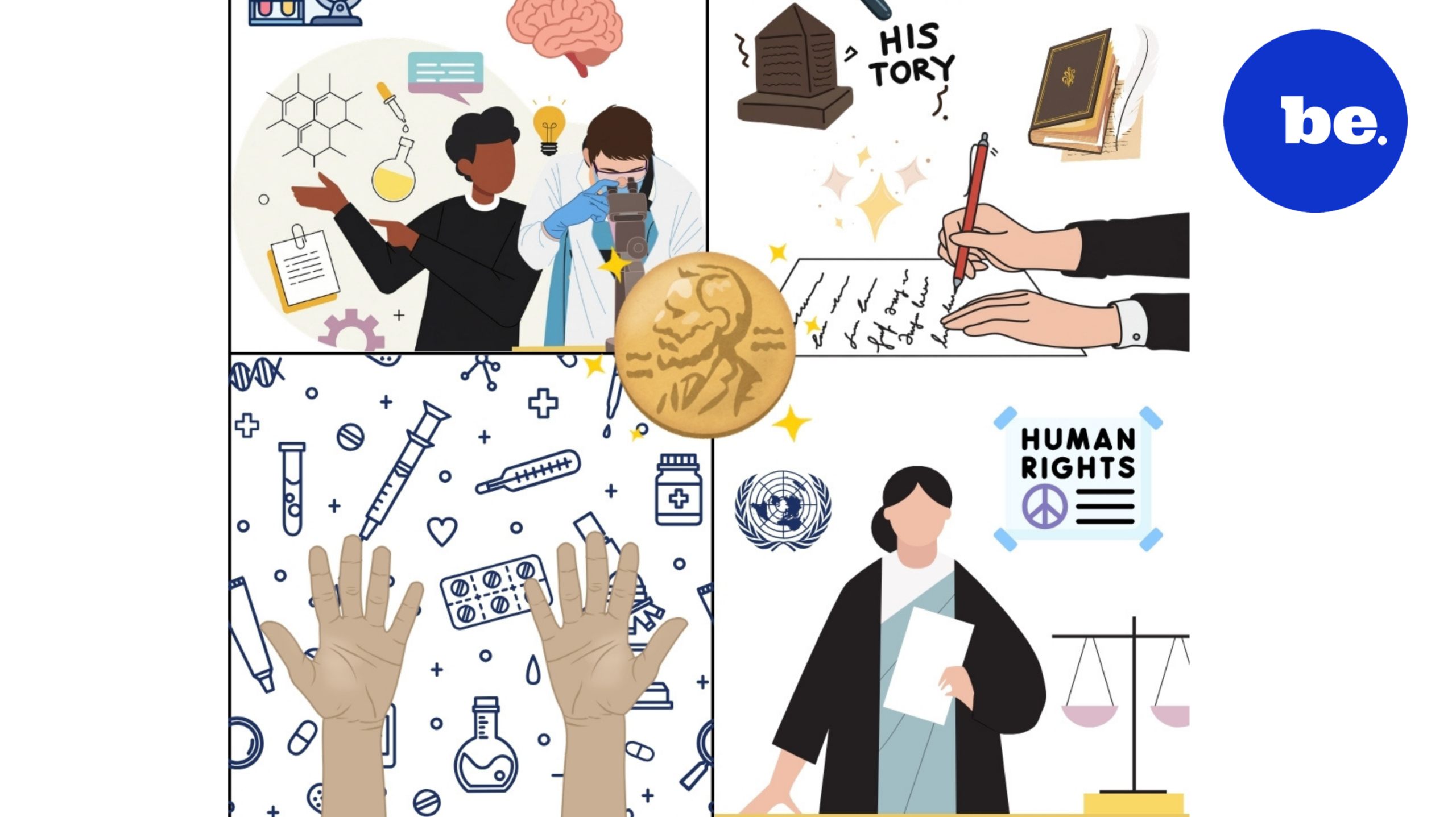
Ever since, the Nobel Prize has gone to people whose achievements helped elevate humanity. It usually starts with simple curiosity and a desire to change things. So let’s turn a few pages and meet the 2026 Nobel Prize winners.
Karl Deisseroth once wanted to be a writer. Instead, he ended up in a research lab at Stanford University, trying to figure out how the human brain works. Now, he shares the Nobel Prize in Physiology or Medicine with Peter Hegemann and Georg Nagel for their discoveries about light-sensitive ion channels and optogenetics. Deisseroth helped build a method that uses light to switch specific nerve cells on and off. Now, scientists can see how brain cells link up. Looking at old questions from a new angle, just how a writer would think.
Let’s travel from the brain to the bottom of the world. Trillions of tiny particles called neutrinos pass through our bodies. Belgian physicist Francis Halzen spent his career trying to find out where they come from. His big idea became the IceCube Neutrino Observatory, a huge telescope buried under the Antarctic ice. He received the Nobel Prize in Physics for his role in IceCube, which helped capture the signals neutrinos gave off when they hit matter. His story shows how chasing a clue you can’t even see can change the way we see the unknown.
Chemistry has always had exceptions. Henri B. Kagan and Kenso Soai winning the Nobel Prize in Chemistry for their work on “handed” molecules is one of them. Like your left and right hands, these molecules are mirror images, and that small difference can change how a medicine works. Not bad for two people who kept asking about something too small to be seen.
After all the triumphant science stories, comes the literary genre of brilliance. Canadian writer Anne Carson received the Nobel Prize in Literature for her bold and inventive work. She took old ideas and gifted them with a new life in modern writing. Moreover, Robert E. Hall and Michael Woodford jointly received the Sveriges Riksbank Prize in Economic Sciences, also known as the Nobel Prize in Economics, for developing Keynesian models that help quantify stabilisation policy affecting business cycles and shift the paradigm for managing economic downturns.
Finally, Navanethem “Navi” Pillay received the Nobel Peace Prize for her work promoting human rights and international law. As a jurist, she worked to hold people accountable for committing grave war crimes and other offences at the International Criminal Court (ICC), paving the way for justice for oppressed people.
Some people turn their curiosity into discoveries that help make the world a better place. Curiosity and exploration are the only commonalities for all achievers. While the Nobel Prize brings a multitude of honour and recognition to the Laureates, the real value lies in the contributions they made in shaping a better world.